
How Bike Helmet Safety Standards Protect Cyclists on the Road
Imagine cruising down a sunny road, wind in your face, when a sudden pothole sends you tumbling. In that split second, your helmet becomes your best friend. Bike helmets save lives every day, but not all offer the same protection. Strong bike helmet safety, like the reliable Batfox bike helmet, follows strict standards that make the difference between a close call and tragedy.
Governments and experts set these standards through years of research. For instance, the CDC reports that helmets reduce head injury risk by up to 88% and brain injury risk by 65%. Another study shows helmeted cyclists face 50% lower odds of serious head trauma in crashes. These numbers prove the value of certified protection.
Today, cyclists enjoy better safeguards than ever. Standards keep evolving, and independent tests push innovation further. This guide breaks down how these rules work and why they matter on every ride.
Why Bike Helmet Safety Standards Exist
Cyclists face real risks on the road. Head injuries cause most cycling fatalities, yet many crashes are preventable. Standards emerged to fix early helmet flaws that failed in real impacts.
First, regulators noticed weak straps and poor coverage left riders vulnerable. Then, lab tests revealed some shells cracked too easily. As a result, mandatory rules appeared in the 1990s.
Now, every helmet sold in major markets passes tough checks. Manufacturers test multiple samples, not just prototypes. Additionally, standards cover impact absorption, strap strength, and field of vision.
These rules protect you directly. A certified helmet spreads force across foam, cutting peak energy to the skull. Moreover, proper design prevents the helmet from shifting or flying off.
Standards also drive progress. Brands compete to exceed basics, adding features like rotational protection. Consequently, today’s helmets perform better than those from a decade ago.
Major Bike Helmet Safety Standards Explained
Different regions use specific certifications. However, most share core principles: absorb shock, resist penetration, and stay secure.
CPSC: The U.S. Standard
The Consumer Product Safety Commission mandates CPSC certification for all U.S. helmets since 1999. Testers drop headforms from about 2 meters onto flat anvils and 1 meter onto curb shapes.
Acceleration must stay below 300g. Straps hold without stretching more than 30mm under heavy pull. Furthermore, coverage extends lower on children’s models for extra safety.
CPSC focuses on common falls. It ensures broad protection for everyday riders.
EN 1078: Europe’s Go-To Certification
Europe requires EN 1078 for cycling, skate, and scooter helmets. Drops hit from 1.5 meters on flat surfaces and lower on curbs.
Straps endure similar retention tests. Ventilation holes prevent sharp objects from penetrating. Additionally, the standard checks stability during oblique impacts.
Many global brands meet both CPSC and EN 1078. This dual compliance makes helmets versatile across markets.
Snell Certification: Going Beyond Minimums
The Snell Foundation sets voluntary, stricter benchmarks. Snell B-95 and B-90 demand higher energy absorption and lower test lines for more head coverage.
Impacts come from greater heights. As a result, Snell-certified helmets handle severe crashes better. However, fewer road cycling models pursue this due to added weight.
Other Notable Standards
Australia and New Zealand follow AS/NZS 2063, similar to EN 1078 with local tweaks. Virginia Tech’s independent STAR ratings test 24 impacts, including rotational forces, ranking helmets from 1 to 5 stars.
MIPS and similar layers reduce brain strain in angled hits. Many top-rated helmets now include these technologies.
How Helmets Undergo Rigorous Testing
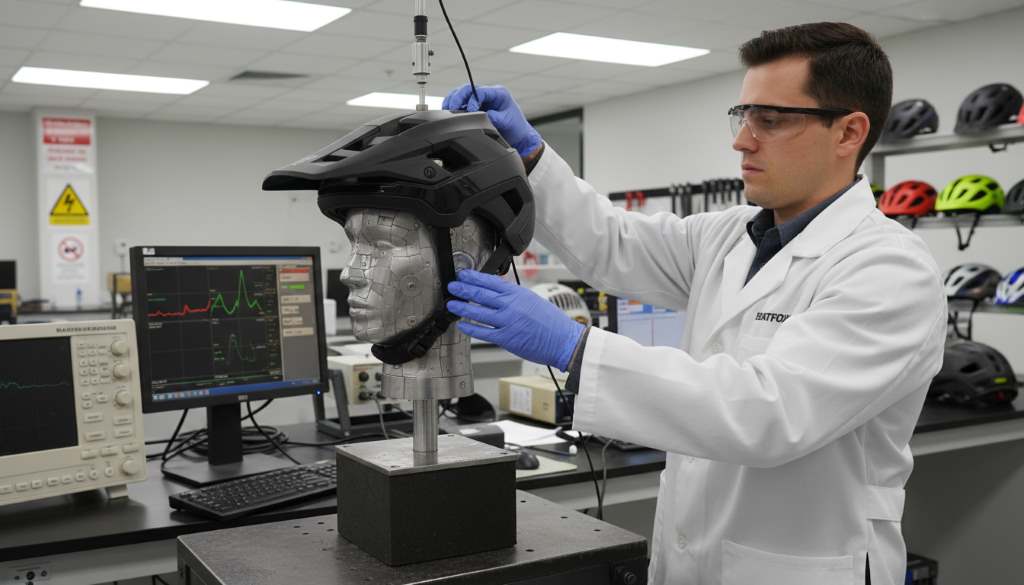
Testing simulates real crashes accurately. Labs mount helmets on magnesium headforms filled with sensors.
First, technicians condition samples in hot, cold, wet, and UV-exposed environments. This mimics years of use.
Next, drops target crown, sides, front, and rear. Flat anvils test direct hits. Curb anvils simulate edges. Hemispherical anvils check glancing blows.
Sensors measure linear and rotational acceleration. Limits prevent excessive force to the brain. Additionally, a metal striker tests shell penetration resistance.
Strap tests pull with hundreds of pounds. Buckles must release easily yet hold firm in crashes. Peripheral vision stays at least 105 degrees.
Independent labs verify claims. Failed batches get rejected entirely. This process ensures every helmet performs as promised.
The Science of Protection on the Road
Helmets work through smart engineering. Expanded polystyrene foam crushes on impact, absorbing energy like a car’s crumple zone.
The outer shell spreads force widely. Together, they slow deceleration dramatically.
Modern designs tackle rotational forces too. Angled impacts twist the brain, causing concussions. Technologies like MIPS allow slight slip, reducing strain by up to 40% in tests.
Proper fit multiplies effectiveness. A loose helmet shifts and exposes areas. Snug straps and adjusted dials keep everything stable.
Real crashes confirm lab results. Helmeted riders suffer fewer skull fractures and traumatic brain injuries. Moreover, quick recovery often follows minor falls.
Proven Benefits Backed by Research
Studies worldwide show clear advantages. A 2025 review found helmets cut fatal head injury risk by over 60%.
Emergency room data reveals non-helmeted cyclists face triple the severe trauma odds. Furthermore, facial protection drops upper-face injuries by 65%.
Virginia Tech ratings highlight differences. Five-star helmets reduce concussion risk far more than basic models. For example, top performers score under 10 on their scale, while others exceed 20.
Long-term savings appear too. Fewer hospital stays and rehab needs benefit everyone. Communities with high helmet use report lower cycling casualties.
Related:
Durable Mountain Bikes Under 500: Epic Trails on a Tight Budget
Are BMX for Adults: Unlocking the Thrill of Biking!
Debunking Common Myths About Bike Helmets
Misinformation persists despite evidence. Let’s clear up key myths.
Myth: Helmets only protect in low-speed falls. Fact: Standards test speeds matching road crashes, up to 30+ mph impacts.
Myth: Helmets increase neck injury risk. Fact: Research shows no link; lightweight designs avoid strain.
Myth: Any helmet works fine. Fact: Expired or damaged ones lose effectiveness. Replace after crashes or every 3-5 years.
Myth: Helmets aren’t needed for short rides. Fact: Most crashes happen close to home, unexpectedly.
Myth: Car impacts make helmets useless. Fact: Helmets excel at falls, the most common incident. They still help in vehicle collisions.
How to Choose a Helmet That Meets Top Standards
Start with certification stickers inside. Look for CPSC, EN 1078, or both.
Check Virginia Tech ratings for extra insight. Five-star models offer superior protection.
Prioritize fit over looks. Try several sizes and adjust pads. The helmet should sit level, with straps forming a V under ears.
Consider ventilation for hot rides. MIPS or similar adds rotational safety without bulk.
Replace damaged helmets immediately. Cracks or dents compromise strength.
Proper Fit, Use, and Maintenance Tips
Fit matters most. Measure your head circumference and match brand sizing charts.
Adjust the rear dial snugly. Straps touch lightly under chin, allowing one finger underneath.
Position the front edge one inch above eyebrows. Shake your head; it shouldn’t move.
Clean with mild soap and water. Avoid solvents that degrade foam.
Store away from heat and sunlight. Inspect regularly for wear.
Teach kids early. Model good habits and check their fit often.
Conclusion
Bike helmet safety standards deliver proven protection through careful testing and smart design. They absorb impacts, secure straps, and now handle rotational forces effectively.
Research confirms helmets slash injury risks dramatically. Certified models, especially high-rated ones, give cyclists confidence on every road.
Choose a helmet that fits well and meets strong standards. Wear it consistently, no exceptions. Your brain deserves this simple safeguard.
Next ride, strap on certified protection. Stay safe and enjoy the freedom of cycling.
FAQs
What is the most important bike helmet safety standard?
CPSC serves as the U.S. mandatory baseline. However, Virginia Tech’s independent ratings reveal real-world differences best.
Do all bike helmets meet the same safety standards?
No. Basic ones pass minimums, while premium models add rotational protection and earn higher ratings.
How often should I replace my bike helmet?
Replace after any crash. Otherwise, every 3-5 years due to foam degradation.
Are expensive helmets safer than cheap ones?
Not always. Certification matters most. Many affordable helmets meet standards and perform well.
Can I trust a helmet without a CPSC or EN 1078 sticker?
Avoid it. Legal sales require these certifications in most countries.
References
- Consumer Product Safety Commission Bicycle Helmets Guidance: https://www.cpsc.gov/Business–Manufacturing/Business-Education/Business-Guidance/Bicycle-Helmets
- Virginia Tech Bicycle Helmet Ratings: https://www.helmet.beam.vt.edu/bicycle-helmet-ratings.html
- Helmets.org Standards and Statistics: https://helmets.org/standard.htm
- CDC Bicycle Safety Facts: https://www.cdc.gov/pedestrian-bike-safety/about/bicycle-safety.html