Advanced Insulation Techniques to Enhance Indoor Comfort
Key Takeaways
- Advanced insulation boosts comfort, energy efficiency, and sustainability.
- Aerogel, VIPs, and multi-layer foils offer high thermal resistance with minimal space.
- PCMs and smart systems stabilize temperatures and reduce energy use.
- PDRC and CABS provide passive or adaptive climate control.
- Upgrading insulation lowers energy bills, improves indoor comfort, and supports greener buildings.
Introduction
Ensuring a comfortable indoor environment is a top priority for both residential and commercial spaces. Advanced insulation methods are vital for effective temperature regulation, improved energy efficiency, and enhanced year-round comfort. These cutting-edge techniques are increasingly adopted not only for their performance but also for helping meet sustainability goals across different climates. For those seeking ways to optimize comfort, exploring modern wall insulation companies Denver can be an essential first step toward transforming indoor conditions.
Understanding the importance of reliable insulation means going beyond traditional options. Innovative advancements such as aerogel, phase change materials, vacuum-insulated panels, and new smart automation systems enable homeowners and business owners to create comfortable, sustainable indoor environments.
Aerogel Insulation: The Lightest Solid Insulator
Aerogel insulation stands out for its superior performance, boasting R-values of 8-10 per inch, which is almost three times higher than conventional fiberglass. Its composition, made of over 99 percent air held in a web of silica nanostructures, provides high resistance to heat flow while remaining extremely light. Aerogel’s robust properties make it suitable for demanding settings, from homes to industrial and aerospace applications.
Phase Change Materials (PCMs): Smart Thermal Regulation
PCMs are unique materials that can store and release heat as they change from solid to liquid. By integrating PCMs into structures such as drywall panels or ceiling tiles, buildings can significantly reduce temperature swings within. When indoor temperatures rise, PCMs absorb excess heat, and when temperatures fall, they gradually release the energy they have stored. This dynamic response supports a more consistent comfort level and decreases dependence on heating and cooling systems.
Vacuum Insulated Panels (VIPs): High Thermal Resistance in Slim Profiles
VIPs hold a central place in space-saving, designed buildings, offering R-values as high as R-50 per inch. Each panel contains a core tightly compressed and sealed within a multi-layer film barrier, blocking air and vapor ingress. Their effectiveness depends on meticulous installation to prevent punctures or air leaks, which can compromise their insulation properties. Despite the need for expert installation, VIPs are increasingly used in new builds and retrofits, especially where thickness constraints are a concern.
Multi-Layer Foil Systems: Reflective Insulation
Multi-layer foil insulation systems combine alternating layers of reflective materials and foam or fiber spacers. Just 1/4 inch thick, these systems leverage controlled air gaps to create thermal breaks, resulting in R-values between 5 and 8 per inch. Their true advantage appears in hot climates, where reflective surfaces dramatically lower heat gain, reducing cooling costs by up to 35% when properly installed. According to the U.S. Department of Energy, investing in such insulation can lead to considerable long-term savings and emission reductions.
Smart Insulation Systems: Adaptive Thermal Management
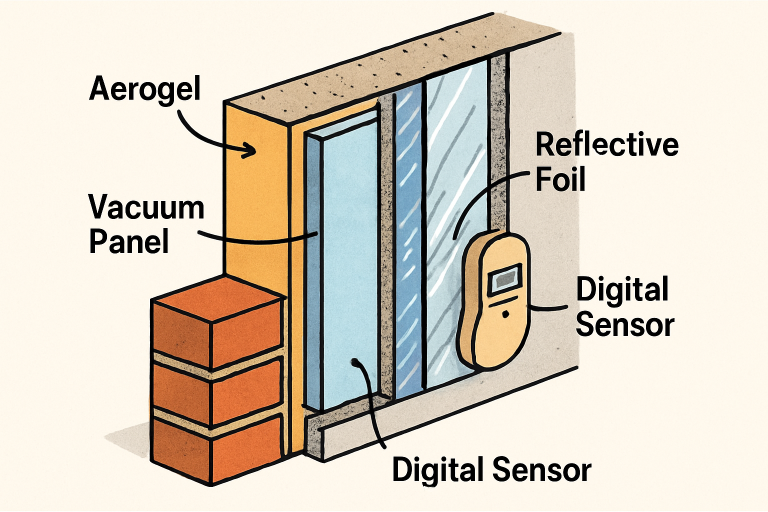
Smart insulation systems leverage digital sensors and connectivity to automatically adjust a structure’s thermal resistance in real time. Tiny IoT-enabled sensors monitor temperatures, humidity, and even air movement, transmitting data to automated controllers that adjust insulation levels as required. These dynamic systems adapt to changing weather patterns and indoor needs while reducing unnecessary energy demand, providing both comfort and operational cost control for property owners.
Passive Daytime Radiative Cooling (PDRC): Energy-Free Cooling
PDRC is an emerging technology that uses advanced materials that can both reflect sunlight and emit heat into the atmosphere, cooling surfaces below ambient temperatures without electricity use. This approach, when applied to roofs and building envelopes, provides meaningful cooling on hot days and reduces peak energy consumption. Recent research has highlighted its potential to mitigate urban heat effects and contribute to resilient green building solutions.
Climate-Adaptive Building Shells (CABS): Responsive Architecture
Modern building shells, known as CABS, are designed to actively adjust their thermal, light, and ventilation properties. Unlike traditional stationary walls and roofs, climate-adaptive solutions use materials or mechanical features to respond to natural light, temperature, and even occupant presence. This means that the exterior of a building can regulate solar gain or loss, making interiors more consistent and comfortable throughout seasonal changes while radically improving energy performance. CABS are increasingly seen in innovative architectural projects and green-certified buildings.
Final Thoughts
Advanced insulation techniques are transforming how individuals and organizations manage indoor comfort and sustainability. Whether you opt for aerogel, PCMs, VIPs, or sophisticated smart solutions, each contributes to a more effective envelope against temperature extremes and energy waste. The adoption of these technologies makes indoor spaces more pleasant, reduces energy bills, and helps build toward a greener, more resilient future. For anyone considering new construction or upgrades, exploring these insulation advancements is a crucial investment in both comfort and sustainability.