

How Far Can a Budget Golf Hunting Rangefinder Really Measure?
You found the perfect ridge, set up your shooting sticks, and glassed a buck at what looks like 500 yards. But your budget rangefinder only claims a maximum range of 600 yards on reflective targets. Will it get the job done, or will it leave you guessing? The truth about budget hunting rangefinder performance is often hidden in the fine print. Manufacturers advertise bold maximum distances, but real-world conditions—like target color, brush, and lighting—drastically cut that number down. For most hunters, a budget rangefinder that reliably reaches 300 to 400 yards on deer-sized game is sufficient for ethical shots, but understanding where those limits actually fall can save you from a costly miss or a broken hunt.
What Does “Maximum Range” Actually Mean for a Budget Hunting Rangefinder?
The maximum range printed on the box almost always refers to the distance the laser can reach a highly reflective target, such as a road sign, white building, or a specialized prism. For a budget hunting rangefinder, this number is often inflated by 50 to 100 percent compared to what you will get on a brown animal in low light. If a unit advertises 600 yards of range, you should realistically expect it to acquire a deer at around 350 to 400 yards under good conditions. The key metric you need to look for is the “deer” or “animal” range, which budget models rarely advertise honestly.
Reflective vs. Non-Reflective Targets
Budget laser engines are simply less powerful. They struggle to bounce a signal off of dark, non-reflective surfaces like a bear or a thick pine tree. A reflective target sends nearly 100% of the laser back, while a deer might only return 10-20%. This is why you need to subtract roughly 30-40% from the stated maximum to get your effective hunting range.
How Do Real-World Conditions Affect Budget Rangefinder Distance?
Real-world conditions are the silent killers of budget hunting rangefinder distance. Fog, rain, bright sun, and even heat mirage can cut your effective ranging ability by half. Budget units lack the signal processing power to filter out atmospheric interference, meaning you will get “error” messages or no reading at all in challenging weather. For a budget model, your best performance will always come on a clear, overcast day with a steady rest.
Lighting and Target Color
- Bright Sunlight: Washes out the return signal. Expect 20-30% range loss.
- Dusk/Dawn: The best time for budget rangefinders; low light reduces interference and extends range slightly.
- Target Color: White or light gray targets are easy. Dark brown or black targets (like a black bear) are difficult and will reduce range by up to 50%.
Which Budget Rangefinders Offer the Best True Distance?
Budget models from brands like Halo, Vortex (Crossfire line), and Sig Sauer (Buckmasters series) generally offer the best real-world performance for the price. Typically, a $100–$150 rangefinder will reliably hit 300 yards on a deer. A $200–$250 unit may push that to 400 yards. If you need to range a target consistently beyond 400 yards, you are leaving the “budget” category entirely. The sweet spot for affordability and performance is a unit that guarantees 400 yards on a deer with 7x magnification.
| Price Range | Advertised Max Range | Realistic Deer Range | Best Use Case |
|---|---|---|---|
| $80 – $120 | 400 – 500 yards | 200 – 300 yards | Archery / 100-yard rifle |
| $120 – $180 | 500 – 650 yards | 300 – 400 yards | Mid-range rifles / 300-yard shots |
| $180 – $250 | 600 – 800 yards | 350 – 450 yards | Long-range budget setups |
Can a Budget Rangefinder Handle Archery and Rifle Hunting?
Yes, a budget rangefinder can handle both disciplines, but you need to prioritize different features depending on your weapon. For archery, scan speed and angle compensation (ARC) are critical. Most budget units now offer ARC, but they are often slower to lock onto a target than premium units. For rifle hunting, you need raw distance capability and a clear, crisp display. A budget unit that works well for a rifle hunter at 400 yards might be frustratingly slow for a bow hunter trying to range a 40-yard buck in thick brush.
Key Features to Look For
- Scan Mode: Essential for bow hunters to range multiple targets quickly.
- Angle Compensation: Critical for both bow and rifle hunters in mountainous terrain.
- Target Lock: A feature that confirms you have hit the intended target, not a background tree.
Why Do Budget Rangefinders Fail at Long Distances?
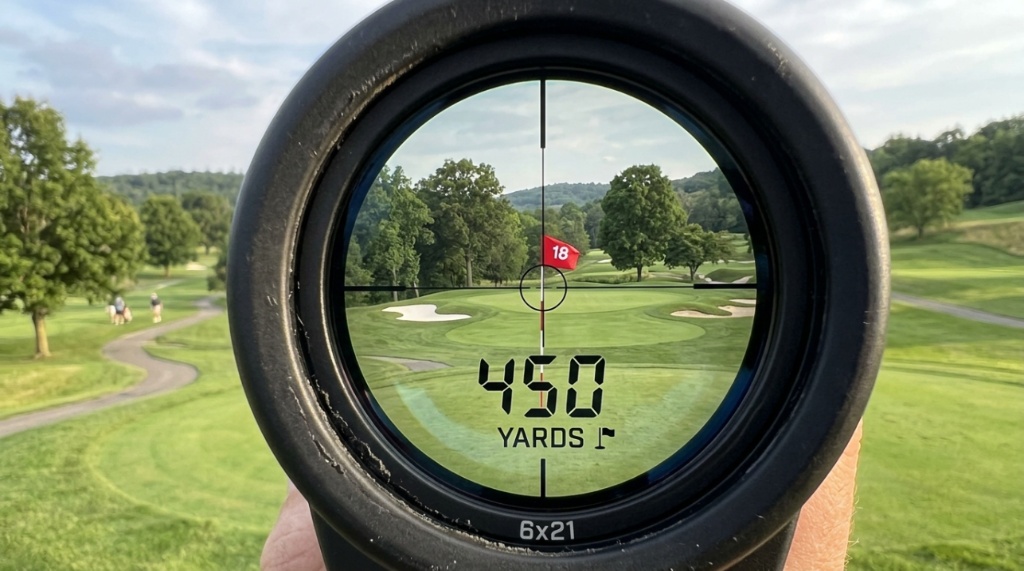
Budget rangefinders fail at long distances primarily due to inferior optics and weaker laser diodes. The glass in a budget unit transmits less light, making it harder to see and aim at a small target far away. The laser itself has lower peak power and a wider beam divergence. A wider beam means the laser “splash” may hit a branch or rock in front of your target, giving you a false reading. At distances beyond 400 yards, a premium unit will have a tight 0.5 milliradian beam, while a budget unit may have a 2.0 milliradian beam, which is four times wider and significantly less accurate.
How Can You Test Your Budget Rangefinder’s True Range?
You can test your rangefinder’s true hunting range in your backyard without expensive equipment. Find a dark-colored object (a black trash bag or a brown cardboard box) and place it at a known distance using a golf GPS or a measuring wheel. Start at 100 yards and move back in 50-yard increments. Record the furthest distance where the rangefinder gives a consistent reading every single time. Do not count a reading that only appears once out of ten attempts.
Step-by-Step Test
- Set up a dark target at 100 yards. Confirm the reading.
- Move the target to 200 yards. Test 5 times.
- Repeat at 300, 350, 400, and 450 yards.
- Note the last distance where you got 5/5 successful reads.
- This is your “ethical hunting range” for that specific unit.
Keep Your Gear Protected: While figuring out your yardages on the course, don’t let unexpected weather ruin your round or your electronics. Pair your rangefinder with one of the Windproof Golf Umbrellas for Stormy Golf Days to stay completely dry during heavy downpours.
Is It Worth Buying a Budget Rangefinder for Elk Hunting?
For elk hunting in open country, a budget rangefinder is a significant risk. Elk are often spotted at ranges exceeding 400 yards, and the terrain creates glare and mirage. A budget unit will struggle to cut through the thermal heat rising off a sagebrush basin. If you are hunting elk in timber at close range (under 200 yards), a budget rangefinder is perfectly fine. However, for mountain hunting where a 500-yard shot is possible, you need to invest in a mid-tier unit with better glass and signal processing. A miss due to a rangefinder error is a risk most elk hunters cannot afford.
How Does Battery Life Impact Budget Rangefinder Distance?
Battery life directly impacts laser performance. As a budget rangefinder’s battery drains, the laser becomes weaker, and your effective ranging distance shrinks. Many budget units use standard CR2 batteries that lose voltage quickly in cold weather. A fully charged unit might reach 350 yards on a deer, but at 20 degrees Fahrenheit with a half-drained battery, that range may drop to 200 yards. Always start a hunt with a fresh battery, and carry a spare. Some premium budget models now feature auto-shutoff and low-battery indicators, which are essential for maintaining performance.
When Should You Upgrade From a Budget Rangefinder?
You should upgrade from a budget rangefinder when you consistently find yourself shooting beyond 300 yards for rifle or when your unit fails to read a target in moderate cover. If you have missed an animal because your rangefinder gave a false reading or could not lock onto a target, it is time to invest in better technology. Another clear sign is if you frequently hunt in fog, rain, or heavy brush. Budget units are excellent for learning and for close-range hunting, but they become a liability when the shot is critical and the distance is long.
What Is the Best Way to Extend Your Budget Rangefinder’s Range?
You can extend your budget rangefinder’s effective range by using a steady rest, shooting in lower light, and aiming for the brightest part of the animal. Instead of aiming at the dark body of a deer, aim for the lighter chest or the white throat patch. For maximum distance, use a tripod or a shooting stick to eliminate hand shake. Even a small amount of movement confuses the laser sensor on budget units. Additionally, cleaning the lens with a microfiber cloth can improve light transmission by 5-10%, giving you a slight edge in ranging ability.
Frequently Asked Questions
Can a budget rangefinder really range 600 yards?
Yes, on a highly reflective target like a white barn or a road sign. On a deer-sized animal, a 600-yard budget rangefinder typically only reaches 300-400 yards under ideal conditions.
What is the best budget rangefinder for bow hunting?
The best budget rangefinder for bow hunting is one with fast scan mode and angle compensation. Models like the Halo XL or Vortex Crossfire HD are popular for their reliable performance under 80 yards.
Do budget rangefinders work in the rain?
Budget rangefinders struggle significantly in rain. Water droplets scatter the laser beam, reducing effective range by 40-60%. It is best to avoid using them in heavy precipitation.
How accurate are budget hunting rangefinders?
Most budget hunting rangefinders are accurate to within +/- 1 yard up to 200 yards. Beyond 300 yards, accuracy can drop to +/- 3 yards or more, which is still acceptable for ethical hunting shots.
Is angle compensation important on a budget rangefinder?
Yes, angle compensation is very important for bow hunters and any hunter in steep terrain. It calculates the horizontal distance, which is the true distance for an arrow or bullet drop.
Why does my budget rangefinder show “error” on a long target?
An “error” usually means the laser return signal is too weak. This happens when the target is too far, too dark, or the conditions are too bright. Steadying the unit on a rest can often help.
Can I use a golf rangefinder for hunting?
No, golf rangefinders lack the reflectivity settings and multi-coating needed for natural surfaces. They are optimized for bright white flags and will fail to range a brown deer at distance.
Conclusion
Budget hunting rangefinders are capable tools, but they demand honesty from their owners. The advertised 600-yard range is a marketing number, not a hunting number. For practical use, expect a budget unit to deliver reliable performance on deer-sized game at 300 to 400 yards in good conditions. This is more than enough for most whitetail and hog hunters, but it falls short for serious mountain hunters. Understand your unit’s limitations, test it before the season, and keep a fresh battery in your pack. If your hunting style stays within these realistic boundaries, a budget rangefinder is an excellent value. If you need more reach, consider stepping up to a mid-tier option. To compare models that balance cost with genuine long-range performance, review our full guide on hunting rangefinder distance to find the perfect tool for your next hunt.