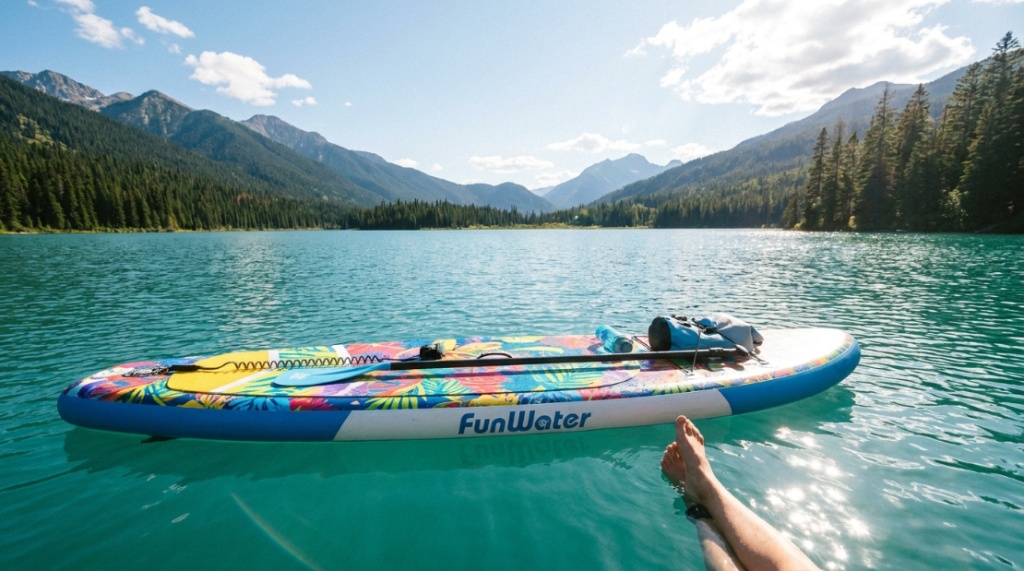
Why Is the FunWater Board a Popular Choice?
Inflatable paddle boards have exploded in popularity, but with so many brands and models on the market, choosing the right one can feel overwhelming. If you’ve been researching iSUPs, you’ve almost certainly come across the FunWater board. It’s frequently cited in forums, review roundups, and social media feeds as a go-to option for budget-conscious paddlers. But is the hype justified, or is it just a low-cost compromise? This article explores the specific features, performance trade-offs, and real-world considerations that explain why the FunWater board continues to attract attention from beginners and intermediate paddlers alike.
Key Takeaways
- FunWater boards offer a rare balance of accessible pricing and durable military-grade material, making them a low-risk entry point for new paddlers.
- The availability of multiple sizes and thickness options means the brand can accommodate a wider range of rider weights and preferred stability levels than many direct competitors.
- Included accessory kits are generally complete, but the paddle and manual pump are common upgrade points for users who progress quickly.
- While FunWater is not a premium performance brand, its direct-to-consumer model and attention to thickness and design details provide value that matches or exceeds boards costing significantly more.
What Exactly Is the FunWater Board?
FunWater is a manufacturer of inflatable water sports equipment, primarily known for its stand-up paddle boards. They follow a direct-to-consumer sales model, selling primarily through online marketplaces like Amazon and their own web storefronts. For many buyers, a FunWater board serves as their first serious introduction to paddle sports because it undercuts the price of established industry giants like Red Paddle Co or Tower Paddle Boards while promising competent construction.
Unlike “generic” unbranded inflatables, FunWater provides distinct model lines, official warranties, and a degree of customer support infrastructure, which instills more confidence in a first-time buyer. The boards are designed to bridge that gap between cheap, questionable toys and premium expedition boards. They concentrate on the “middle class” of paddle boarding—recreational cruising, light fitness paddling, and yoga—rather than specialized surf or whitewater disciplines.
Why Do Paddlers Choose the FunWater Board?
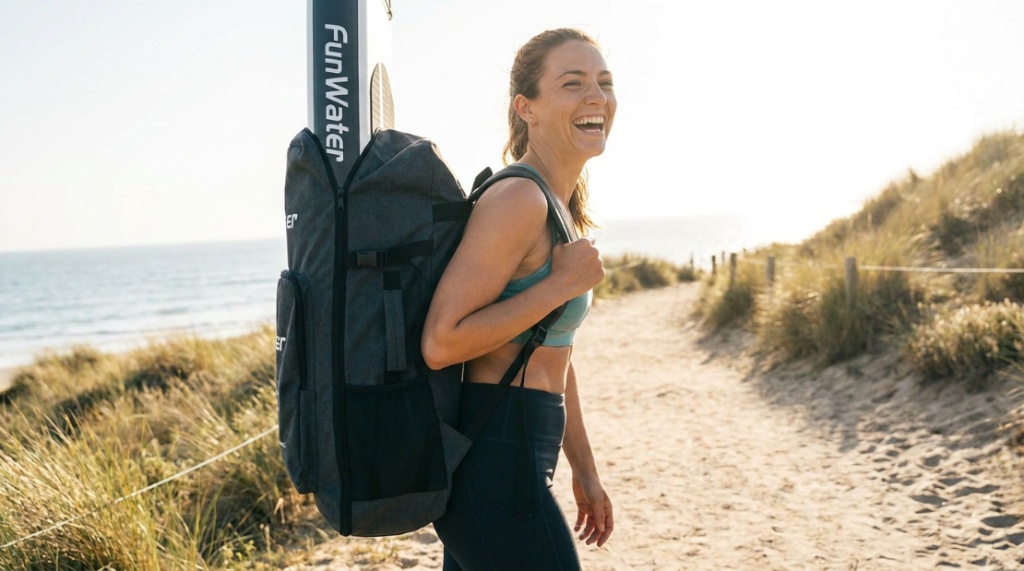
The attraction usually stems from a combination of brand positioning and specific manufacturing details that matter on the water. It is not about having the lightest or fastest board on the market; it’s about getting the most usable performance for the price point.
The Value Proposition: Price Versus Performance
The primary market disruptor is price. FunWater consistently prices its boards well below the $500–$700 threshold that is common for recognized touring brands. This pricing strategy opens the sport to a wider demographic, including families purchasing multiple units and college students on tight budgets. The logic is simple: if a $350 board can perform 85% as well as a $650 board, the value equation is compelling for a recreational user.
Durable Construction Materials
One of the most significant reasons for the brand’s popularity is the use of “military-grade” PVC. It’s easy to dismiss that term as marketing fluff, but in the context of budget boards, it denotes a specific thickness and weave density that resists punctures and abrasions. FunWater utilizes drop-stitch construction, which allows the boards to be inflated to high pressures—usually around 15 PSI (pounds per square inch). Higher PSI equals a stiffer board, which translates to better tracking and less “bending” in choppy water. They avoid the flimsy feel associated with cheap inflatables that only support 10–12 PSI.
Excellent Stability for Beginners
Stability is the primary concern for anyone stepping onto a board for the first time. FunWater addresses this by offering different size options rather than a one-size-fits-all approach. Their wider models—often 32 to 34 inches across—provide a massive, stable platform. This makes learning to stand, turn around, and retrieve a dropped paddle much less intimidating. The displacement and volume help the board glide rather than bob excessively, which reduces the “wobble factor” that causes new paddlers to fall.
Product Range: Finding the Right Size and Shape
Not all FunWater boards are created equal. Understanding the difference between their standard models and their “All-Around” or “Yoga” lines is crucial to getting the right board for your weight and intended use.
Understanding Dimensions: Length, Width, and Thickness
- Length (10’6″ vs. 11′): Longer boards track straighter and have higher top speeds, while shorter boards are easier to maneuver. Their 11-foot option is better suited for cruising and slight touring, while the 10’6″ is more nimble for surfing small waves.
- Width (30″–34″): If you weigh over 180 lbs or plan to bring a child or dog along, choose the wider 34″ model. For lighter paddlers looking for speed, a 30″ width is more efficient.
- Thickness (6″ vs. 5.5″): This is the most technical spec. A 6-inch thick board is the industry standard for maximum rigidity and weight capacity. Some of the lighter/budget “travel” models might only be 5.5 inches thick, which saves weight but feels noticeably more flex-prone on the water.
Comparing FunWater Models
| Feature | All-Around Series | Wide Stability Series |
|---|---|---|
| Best Suited For | General fitness, light touring, mixed conditions | Yoga, fishing, larger paddlers, absolute beginners |
| Typical Width | 30″ – 32″ | 34″ |
| Weight Capacity | Up to 300 lbs | Up to 400 lbs |
| Primary Advantage | Faster gliding and better tracking | Maximized stability and cargo space |
| Limitation | Requires more balance and effort | Slower paddling speed due to drag |
What’s Included in the Accessory Kit?
Purchase price is only half the cost equation. Many brands force you to buy the board “bare,” requiring separate purchases for paddles, leashes, and bags. FunWater’s decision to bundle these items is a major driver of its popularity. The full kit usually includes a coil leash, a repair kit, a high-pressure pump, a waterproof phone bag, a wheeled carrying backpack, and a three-piece aluminum paddle.
Accessory Quality: What to Keep and What to Upgrade
It’s important to be honest about the build quality of these “freebies.” The included backpack is surprisingly functional, offering shoulder straps and a large capacity, but it is not designed for air travel. The pump works effectively but will require significant exertion to reach the recommended 15 PSI—a dual-action pump is much faster.
The aluminum paddle is the weakest link in the chain. It is durable, but it is heavier than fiberglass or carbon options. After a few miles, this extra weight becomes noticeable. Most FunWater owners eventually upgrade to a lighter carbon paddle, but the included one is perfectly serviceable for a season of learning Once your board sees some wear and tear on the water, you can easily restore its fresh finish by learning repaint a surfboard or paddleboard like a pro.
Performance on the Water: Stability, Speed, and Tracking
Once you are past the unboxing stage, the real question is: how does it paddle? The FunWater board has a semi-rigid feel at the correct pressure. It lacks the “snap” and responsiveness of a high-end touring board, but it handles the fundamental motions of paddling with grace.
Tracking and Maneuverability
Beginners often struggle with keeping a straight line. The FunWater boards feature a removable center fin. This fin is deep enough to provide solid tracking, meaning fewer corrected strokes on the non-dominant side. However, because the boards are on the wider side, they will never win races. Turning is a deliberate process that involves sweep strokes, but the nose comes around predictably without catching water.
Balancing Rigidity and Weight
At approximately 20 to 22 pounds for the board alone, it is manageable for most adults to carry short distances. However, it is not the lightest board on the market. The rigidity achieved at 15 PSI comes at the cost of some weight. For a paddler with a longer walk from the car to the water, a lighter board might be a more important factor than price.
Who Should Buy a FunWater Board? (And Who Shouldn’t?)
Knowing who this board is *not* for is just as important as knowing who it is for. This specificity helps clarify its popularity.
Ideal Users for FunWater
- Weekend Warriors: If you plan to paddle a few times a month on calm lakes or slow rivers, this board is more than adequate.
- Families: Because of the competitive price, outfitting a family of four with FunWater boards is feasible, enabling group paddling trips that would otherwise be prohibitively expensive.
- Travelers (Car-Based): The inflatable nature means it fits in the trunk of a sedan or an RV bay, making it easy to spontaneously launch from random access points.
Users Who Should Look Elsewhere
- Hardcore Tourers: If you plan to cover 10+ miles per session, the draft and width will create fatigue. You need a longer, narrower, and lighter displacement hull.
- Surfers: Inflatable boards are bouncy in waves. For dedicated surfers, a hard epoxy board is a better investment.
- Weight-Conscious Travelers: If you have strict airline baggage allowances, the combined weight of the board, accessories, and bag (around 30 lbs) may incur excess baggage fees that negate the purchase savings.
Maintenance and Longevity: Getting the Most Out of Your Purchase
To ensure the board lasts for many seasons, proper care is essential. Inflatable boards are durable but vulnerable to heat and sharp objects.
Key Maintenance Mistakes to Avoid
The most common way to damage an iSUP is by over-inflation on a hot day. When the sun heats the air inside the board, the pressure expands. If you inflated to 15 PSI in the morning shade, it could rise to 17 PSI by noon, straining the seams. Always bleed a little air if you leave the board in the sun. Additionally, never store the board in a hot car trunk in the summer; extreme heat can weaken the adhesive bonding the chambers.
Cleaning and Storage Tips
Rinsing the board with fresh water after saltwater use is non-negotiable. Salt crystals are abrasive and corrosive to the metal D-rings and fin box. Dry the board completely before rolling it up to prevent mildew. When rolling, avoid sharp folds; roll from the nose down to the tail, leaving the valve open to allow air to escape so the material doesn’t stretch under pressure.
Frequently Asked Questions
Can the FunWater board handle heavy riders?
Yes. FunWater offers specific wide and thick models designed for heavier paddlers. The max load capacity can reach up to 400 lbs on their widest models. However, it is crucial to inflate the board to the maximum recommended PSI (15) to prevent the board from bending under the load, which would otherwise make paddling extremely difficult and inefficient.
How long does it take to inflate the FunWater board?
With the included manual pump, it typically takes 8 to 12 minutes, depending on your stamina and the board’s size. It is not an exact science; the key is to reach the necessary rigidity rather than timing yourself. To speed this up, using an electric air pump is highly recommended, reducing the inflation time to under 3 minutes.
Is the FunWater board good for yoga?
Yes, specifically the wider 34-inch models. The generous deck pad provides enough space for standard yoga stances. The stability allows you to hold poses like downward dog without the board tipping, though you will still feel the “bounce” of the inflatable surface, which requires slightly more core engagement than a hard board.
How fast is the FunWater board?
As a recreational board, it is not built for speed. On the narrower 30-inch model, experienced paddlers can maintain a cruising speed of roughly 2.5 to 3 mph. It will struggle to keep pace with hard-shell touring boards over long distances, but it is fast enough to cover 3–4 miles of coastline comfortably in an afternoon.
Is the warranty reliable?
FunWater provides a standard manufacturer’s warranty that covers manufacturing defects. The company operates an online support system. While it is not comparable to the instant service offered by big-box retailers, they do honor claims related to seam splits or valve defects, provided the damage was not caused by impact or neglect.
Conclusion
The FunWater board has earned its popularity not by being the absolute best paddle board ever made, but by mastering the concept of “enough.” It provides enough durability, enough stability, and enough performance for 90% of the people who want to get out on the water without breaking the bank. For the casual paddler and the budget-conscious beginner, it represents the perfect starting line. While you may eventually outgrow the included paddle or desire a lighter setup, the board itself will serve you well for years of casual use. If you are ready to start exploring the water, focus on finding the specific size model that fits your weight, and you will likely find the FunWater board is a choice you won’t regret.