
How to Select a Supportive Buckwheat Pillow in California
If you’re waking up with a stiff neck, numb arms, or that nagging feeling that your pillow is working against you, you’ve likely started searching for a more robust sleep solution. Standard memory foam and down pillows often lack the adjustability needed for proper spinal alignment. This is where a supportive buckwheat pillow in California becomes a game-changer. Filled with natural hulls, these pillows offer firm, moldable support that holds its shape all night. In this guide, we’ll walk through exactly how to choose the right buckwheat pillow for your sleep style, what to look for in quality and construction, and how to adjust to the unique feel of this natural fill.
Key Takeaways
- Buckwheat pillows provide superior cervical support because the hulls conform to your shape while maintaining firm resistance, preventing the “bottoming out” common with soft fills.
- Fill quantity is the most critical factor for comfort; you may need to remove or add hulls to achieve the loft that aligns your head with your spine.
- Fabric quality matters significantly—a tight-weave, natural cotton or hemp shell controls the noise of the hulls and prevents dust from escaping.
- If you are sensitive to the initial firmness, transition gradually by layering a towel over the pillow or using it for short periods before full nights.
Why Choose a Buckwheat Pillow Over Other Materials?
The core difference between buckwheat and synthetic fills comes down to physics. Memory foam reacts to heat and pressure by slowly molding to your shape, while buckwheat hulls are rigid and immediately displace around your head and neck. This creates a “pocket” effect where the pillow supports your cervical spine without allowing your head to sink too deeply. This is particularly beneficial for back and side sleepers who need consistent elevation to maintain a straight spine. For those seeking a supportive buckwheat pillow in California, the natural fill also offers a significant advantage: it sleeps cool. Since hulls are hollow, air circulates freely through the pillow, wicking away heat that often causes restless nights with foam alternatives.
Determining the Right Fill Amount and Loft
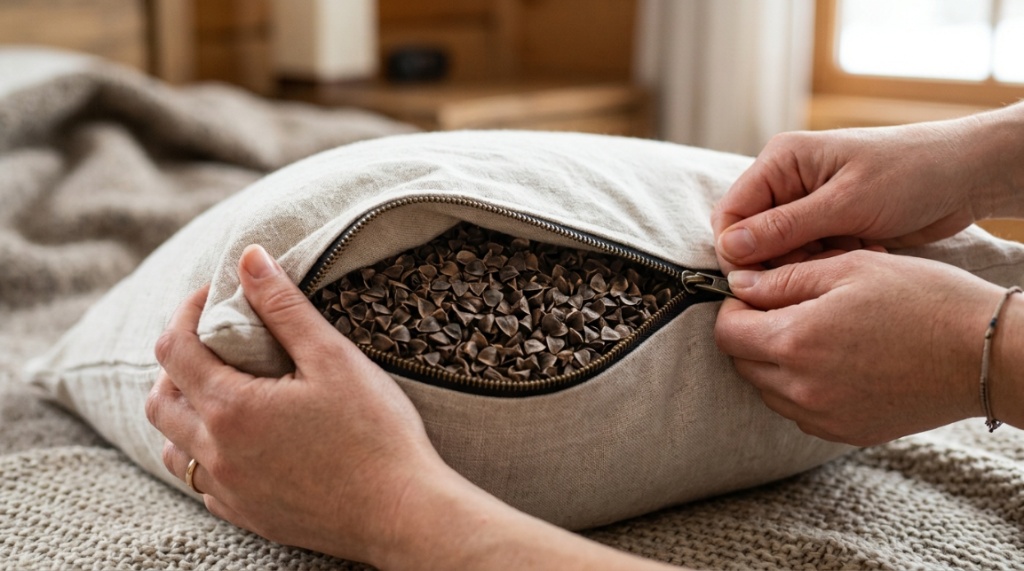
Unlike a standard pillow that is ready to use out of the box, a buckwheat pillow requires customization. The ideal loft elevates your head so that your cervical spine maintains its natural curvature, not tilted up or down. To find the right amount, you need to consider your primary sleep position.
Selecting Fill for Back Sleepers
Back sleepers generally require the least amount of fill. You want a medium loft that supports the curve of your neck while allowing your head to rest slightly back. A pillow that is too high will push your chin toward your chest, causing strain. Start with a pillow that is about three-quarters full and test the angle; it should feel supportive but not propping you up aggressively.
Adjusting Fill for Side Sleepers
Side sleepers typically need the highest loft to fill the space between the ear and the outside of the shoulder. A generic buckwheat pillow is often not full enough for this demographic. You will likely need to add fill to create a firm, tall support column that keeps your head level. Look for options that come with a zipper and a small bag of extra hulls for this adjustment. If the pillow is too low, your upper shoulder will bend into the mattress, creating a “banana” curve in your spine.
Why Stomach Sleepers Should Approach with Caution
Buckwheat is generally too firm and high for stomach sleepers, as it forces the neck into an unnatural, extended position. If you strictly sleep on your stomach, this type of pillow is rarely suitable. If you are a combination sleeper, choose a fill level that accommodates your side and back positions, and simply push the pillow aside or flatten it when rolling onto your stomach.
Critical Features to Look for in a Quality Shell
The hulls do the heavy lifting, but the shell determines the longevity and comfort of the pillow. A poor-quality cover can make the pillow feel abrasive and noisy. Here is what you should inspect before purchasing:
Thread Count and Weave Density
The weave must be tight enough to contain the hulls and fine dust created by the natural buckwheat. A high-thread-count cotton (400 or above) or a durable hemp/cotton blend is ideal. Tightly woven fabric also reduces the sound of the hulls shifting. If you are a light sleeper, the rustling sound of the hulls can be distracting; a thick, soft sateen weave will muffle this significantly, whereas a thin, coarse muslin will amplify it.
The Zipper: Your Customization Tool
Always choose a pillow with a heavy-duty, high-quality zipper. You will use this zipper frequently to adjust the fill level, especially in the first two weeks. Cheap plastic zippers are prone to breaking when stressed by the weight of the hulls. Ensure the zipper is long enough to easily access the inner liner where the hulls sit, not just the outer shell, To complement your bedroom comfort, make sure to Pick Durable Couch Pillows for FL Homes.
Inner Liner vs. Outer Shell
High-end pillows often feature a two-layer design: an inner, tightly woven liner that holds the hulls, and a removable outer shell that is washable. This is a crucial feature. Since you cannot wash the hulls themselves, the ability to unzip and launder the outer cover is vital for maintaining hygiene and extending the lifespan of the pillow.
Understanding the Adjustment Period
It is common to dislike a buckwheat pillow for the first 3 to 5 nights. The firmness feels alien, and the “crunchy” texture is distracting. However, quitting too early means missing out on the long-term benefits. To make this transition smoother, consider the following practical steps:
- Start with a towel layer over the pillow to soften the initial texture.
- Use the pillow for 2–3 hours in the evening while reading or watching TV to build tolerance.
- Remove hulls gradually. It is easier to add them back than to deal with a pillow that is too high.
- Mold the pillow aggressively before lying down. Punch the center to create a well for your head, but keep the firm edge for your neck.
Environmental Factors and Sourcing in California
Living in California presents specific considerations that impact the longevity and care of natural fiber pillows. The state’s varied climate—from humid coastal areas to dry inland valleys—affects both the hulls and the fabric. Buckwheat hulls are hygroscopic, meaning they absorb and release moisture from the air. In humid climates, the hulls can become slightly softer; in dry heat, they may become stiffer. This is not a defect, but a property of the natural material. It is why you may need to adjust the fill amount seasonally.
Cleaning and Maintenance in a Specific Climate
Because you cannot wash the hulls, you must air them out regularly to prevent mildew and musty odors. If you live in a humid area like the Bay Area or coastal Southern California, take the outer cover off and let the inner liner sit in a dry, well-ventilated area for a few hours each month. Avoid storing buckwheat pillows in airtight plastic containers, as trapped moisture can degrade the hulls.
Comparing Fill Quality: Hull Integrity Matters
Not all buckwheat is created equal. The quality of the hulls determines the support durability. When shopping, ask the manufacturer about their cleaning and processing methods.
Whole vs. Broken Hulls
High-quality buckwheat pillows are filled with whole, intact hulls. These are triangular-shaped and act like ball bearings, sliding past one another smoothly. If the hulls are broken or crushed, they create a dusty, gritty substance that compresses flat over time, reducing the lifespan of the pillow and its support capability. A quality pillow will ensure the hulls are triple-cleaned to remove this dust and any debris, which is also crucial for allergy sufferers.
Also, consider the “bounce-back” rate. A high-quality hull should spring back when compressed. If you press down on the pillow and it stays permanently dimpled, the hulls are of poor quality or have been cracked due to overfilling and rough handling.
Price vs. Longevity: A Cost-Benefit Perspective
Buckwheat pillows generally cost more upfront than synthetic versions, but the total cost of ownership is often lower. A typical foam pillow degrades within 18 months, while buckwheat hulls remain supportive for 5 to 10 years if maintained properly. When you buy a buckwheat pillow, you are not just buying a product; you are investing in a long-term sleep aid. Check the manufacturer’s warranty and see if they sell replacement hulls. Some brands offer the ability to refill your existing cover, which is a more sustainable and economical option than replacing the entire pillow.
Frequently Asked Questions
Is a buckwheat pillow hard?
Initially, yes. It is significantly firmer than down or memory foam. However, the “hardness” is different from a solid block; it is a yielding resistance. The hulls move out of the way to conform to your head, providing strong support rather than hard pressure. You can reduce the perceived hardness by removing fill to lower the loft.
Can I use a buckwheat pillow if I have neck pain?
Many users find relief, but it is not a medical device. Buckwheat pillows provide constant, non-compressible support that helps maintain cervical alignment, which can ease stiffness. However, if you have an acute injury, it is always best to consult a physical therapist or chiropractor about the appropriate sleeping posture before switching pillows.
How do I clean a buckwheat pillow?
Do not machine wash the inner liner or hulls. Instead, remove the outer shell and wash it on a gentle cycle. For the hulls, spread them on a large clean sheet in the sun for a few hours to kill dust mites and freshen them. If they get wet, they must be dried immediately to prevent mold.
Why does my buckwheat pillow make noise?
The rustling sound is the hulls shifting against each other. The volume depends on the fabric thickness and how full the pillow is. A pillow that is overfilled will have less room for the hulls to move, resulting in less noise. However, a completely silent pillow is rare; most users find the sound becomes white noise after a few nights.
How long does a buckwheat pillow last?
With proper care, a buckwheat pillow can last anywhere from 5 to 10 years. The hulls may gradually break down or absorb moisture, requiring you to top them up with fresh fill. Eventually, the hulls will turn to dust, at which point they should be replaced entirely.
Conclusion
Selecting a supportive buckwheat pillow in California is not a “buy and forget” experience; it is a process of customization. The keys to success are choosing a pillow with a high-quality, tight-weave shell and a zipper for adjustment, then investing time in dialing in the perfect fill volume for your primary sleep position. Be patient with the adjustment period, and account for your local climate when airing the pillow out. When you get the setup right, the payoff is a stable, cool, and orthopedic sleep surface that holds up for years. Focus on the structure and material quality first, and your neck will thank you for it.